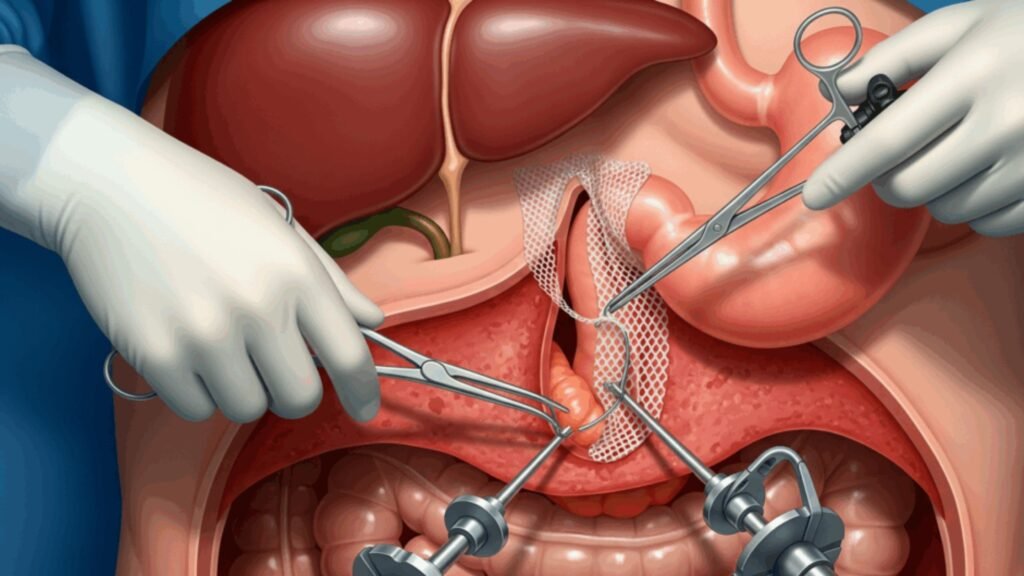
What Exactly Is a Hiatus Hernia?
Somewhere between your chest and your abdomen sits a thin but powerful muscle called the diaphragm. It has a small natural opening called the hiatus through which your esophagus passes to connect with your stomach. When the stomach pushes up through this opening and into the chest cavity, the result is a hiatus hernia.
It sounds alarming, but here’s the thing many people live with a hiatus hernia for years without ever knowing it. It doesn’t always announce itself. And when it does, the symptoms are so common that most people chalk them up to acidity, stress, or a heavy meal. That’s exactly what makes it dangerous.
Your Body Was Sending Signals – Did You Miss Them?
Hiatus hernia doesn’t always shout. Often, it whispers through symptoms that feel ordinary but keep coming back. Watch out for:
- Persistent heartburn that worsens after meals or when lying down
- Frequent acid reflux or a sour taste rising into the mouth
- Difficulty swallowing or a feeling of food getting stuck
- Unexplained chest pain or pressure
- Chronic burping, bloating, or nausea
- Shortness of breath after eating
If these symptoms sound like your daily routine rather than an occasional complaint, it’s time to stop guessing and get properly evaluated.
The Everyday Habits & Hidden Factors Behind It
There’s rarely one single cause. A hiatus hernia typically develops over time due to cumulative pressure and weakening of the diaphragm muscle. Some of the most common contributing factors include:
- Age – Muscle tissue naturally weakens as we get older, making hiatus hernias more common after 50
- Obesity – Excess abdominal weight puts constant upward pressure on the diaphragm
- Chronic coughing or straining – Repeated pressure from constipation, heavy lifting, or persistent coughing
- Pregnancy – Increased abdominal pressure during pregnancy can widen the hiatus over time
- Previous abdominal surgery or injury – Structural changes that affect the diaphragm
Understanding the cause isn’t just academic it directly shapes the treatment approach your hernia surgeon will recommend.
The Real Risk of Ignoring It
How an Untreated Hiatus Hernia Quietly Damages Your Health
A small hiatus hernia that causes no symptoms may not need immediate intervention. But a larger or growing hernia left unaddressed is a different story entirely.
Over time, chronic acid exposure from an untreated hiatus hernia can lead to serious complications esophageal inflammation, ulcers, narrowing of the esophagus, and in advanced cases, Barrett’s Esophagus, a precancerous condition. Beyond the esophagus, a large hernia can compress surrounding structures, causing breathing difficulty and persistent chest discomfort.
The longer it goes unmanaged, the more complex the eventual treatment becomes. Early evaluation is always the smarter choice.
When Medications Work and When They Don’t
Not every hiatus hernia requires surgical intervention. For smaller hernias with mild symptoms, lifestyle modifications combined with medications particularly proton pump inhibitors can effectively manage acid reflux and prevent further damage.
However, medications come with limitations. They suppress acid but do nothing to fix the structural problem. The hernia remains. And for many patients, symptoms gradually return, dosages increase, and quality of life continues to decline despite being on medication.
The Moment Your Hernia Surgeon Steps In
Hernia surgery becomes the recommended path when:
- Symptoms persist or worsen despite consistent medication
- The hernia is large or at risk of complications
- The patient experiences difficulty swallowing, significant chest pain, or breathing issues
- Long-term medication use is causing side effects
- Investigations reveal early esophageal damage like Barrett’s Esophagus
At this stage, consulting an experienced hernia surgeon is not just advisable it is essential.
What Does Hernia Repair Actually Involve?
A Simple Walkthrough of the Surgical Process
Hiatus hernia repair known as hernia repair surgery involves pulling the stomach back into its correct position below the diaphragm, closing the widened hiatal opening, and reinforcing the junction between the stomach and esophagus to prevent acid reflux from recurring.
In most cases, this also involves a procedure called Fundoplication, where the upper part of the stomach is wrapped around the lower esophagus to strengthen the anti-reflux valve naturally. The result is both structural correction and long-term symptom relief something no medication can achieve.
Minimally Invasive Hernia Surgery – Smaller Cuts, Faster Recovery
Modern hernia surgery has come a long way. Today, the majority of hiatus hernia repairs are performed laparoscopically using small keyhole incisions rather than a large open cut. This minimally invasive approach means:
- Significantly less post-operative pain
- Shorter hospital stay – often just one to two days
- Faster return to normal daily activities
- Reduced risk of complications and infection
- Better cosmetic outcomes
For patients who have been putting off surgery out of fear of a long recovery, laparoscopic hernia repair changes that conversation entirely.
Robotic Surgery – The Next Level of Surgical Precision
For cases that demand an even higher degree of accuracy, robotic-assisted hernia surgery is redefining what’s possible in modern hernia repair. Using a robotic system, the surgeon operates with a magnified three-dimensional view of the surgical field and instruments that move with greater flexibility and control than the human hand alone allows.
In hiatus hernia repair, this translates to more precise tissue handling around the delicate diaphragm, reduced trauma to surrounding structures, and consistently better outcomes especially in complex, large, or recurrent hernias. Robotic surgery carries all the benefits of minimally invasive hernia surgery while pushing the boundaries of what surgical precision can achieve.
Your Recovery & Life After Hernia Repair
Recovery from laparoscopic hiatus hernia repair is generally smooth for most patients. In the first few days, a soft or liquid diet is recommended while the surgical site settles. Mild bloating or temporary difficulty swallowing is normal as the body adjusts to its new anatomy and typically resolves within a few weeks.
Most patients are back to light activity within a week and fully recovered within four to six weeks. More importantly, the majority experience a dramatic reduction in heartburn, regurgitation, and the daily discomfort that had become their normal.
For many, it’s the first time in years they sleep through the night without acid waking them up.
Choosing the Right Hernia Surgeon Makes All the Difference
Why Patients Trust Dr. Vishal C Soni for Hiatus Hernia Treatment
Hiatus hernia repair is a procedure where surgical precision and experience directly influence outcomes. The anatomy involved is delicate, the approach must be tailored to each patient, and the decision between different hernia repair techniques requires both expertise and sound clinical judgment.
Dr. Vishal C Soni is a trusted hernia surgeon with extensive experience in managing complex hiatus hernias through minimally invasive hernia surgery. His patient-first philosophy means every treatment decision whether it’s careful monitoring, medication management, or surgical hernia repair is made with your long-term health and quality of life at the center.
If you’ve been living with unexplained heartburn, persistent reflux, or have recently been diagnosed with a hiatus hernia, don’t wait for symptoms to worsen. An early consultation can make all the difference between a simple repair and a complex one.