Why Scarring Is One of the First Things Patients Ask About?
When patients are told they need a rectopexy, the medical questions come first what is it, how long is recovery, will it work? But quietly, often a little later, comes the question most people hesitate to ask out loud: will I have visible scars?
It’s a completely valid concern. Scarring affects how you feel about your body long after the procedure is done. And the honest answer particularly when it comes to robotic rectopexy is far more reassuring than most patients expect.
Open vs. Laparoscopic vs. Robotic Rectopexy – A Quick Comparison
Rectopexy is a surgical procedure that corrects rectal prolapse a condition where the rectum slips out of its normal position. It involves securing the rectum back into place within the pelvis, restoring both function and anatomy.
Traditionally, rectopexy required open surgery a large abdominal incision, a long hospital stay, and a recovery measured in weeks. Laparoscopic techniques improved on this significantly. But robotic rectopexy has taken minimally invasive surgery a step further offering the surgeon greater precision, a three-dimensional magnified view, and instruments with a far greater range of motion than conventional laparoscopic tools allow.
And for patients concerned about scarring, the surgical approach makes all the difference.
How Many Incisions Does Robotic Rectopexy Actually Require?
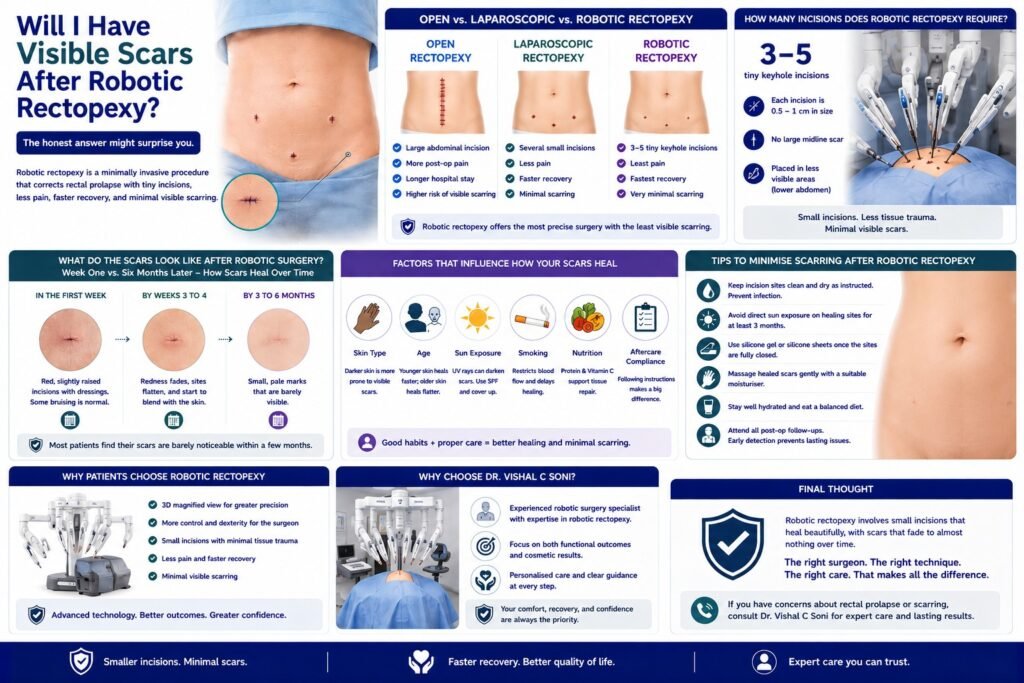
This is where robotic surgery genuinely changes the conversation around scarring. Robotic rectopexy typically requires just three to five small incisions each generally between half a centimetre and one centimetre in size. These are keyhole incisions, not cuts.
Their placement is also carefully considered usually positioned in areas that are naturally less visible, such as the lower abdomen. There is no large midline scar. No wide incision running down the stomach. Just a few small marks that most patients describe as barely noticeable once healed.
Compare this to open rectopexy which can leave a scar several inches long and the difference is significant.
What Do the Scars Look Like After Robotic Surgery?
Week One vs. Six Months Later How Scars Heal Over Time
Understanding how robotic surgery scars evolve over time sets realistic expectations and reduces unnecessary anxiety.
In the first week – The incision sites will appear red, slightly raised, and may have small dressings or adhesive strips over them. Some bruising around the sites is completely normal. This is the body’s natural inflammatory response to healing.
By weeks three to four – Redness begins to fade. The sites flatten and start to blend more naturally with the surrounding skin. Itching at this stage is normal and signals active healing.
By three to six months – For most patients, the incision sites have faded to small, pale marks that are barely distinguishable from the surrounding skin. Many patients report that friends and family cannot tell they had surgery at all.
The small incision size used in robotic rectopexy means there is simply less surface area to scar and less tissue trauma means faster, cleaner healing.
Factors That Influence How Your Scars Heal:
Not every patient heals identically. Several factors influence how visible your scars are after robotic rectopexy:
- Skin type – Darker skin tones are more prone to hyperpigmentation or keloid scarring; lighter skin tends to fade to near-invisible marks
- Age – Younger skin heals faster but can sometimes produce more raised scars initially; older skin tends to produce flatter scars
- Sun exposure – UV exposure on healing incisions significantly darkens scars; keeping sites covered or using SPF is essential
- Smoking – Restricts blood flow to healing tissue and consistently produces poorer cosmetic outcomes
- Nutrition – Adequate protein and vitamin C intake directly supports tissue repair and collagen production
- Aftercare compliance – Following your surgeon’s post-operative instructions precisely makes a measurable difference
Tips to Minimise Scarring After Robotic Rectopexy:
The surgical team’s job is to close incisions with precision what happens after that is largely in your hands. Evidence-backed tips for minimising scarring include:
- Keep incision sites clean and dry as instructed infection is the most common cause of poor scarring
- Avoid direct sun exposure on healing sites for at least three months
- Once the sites are fully closed, silicone gel or silicone sheets applied regularly are among the most effective scar-reduction tools available
- Massage healed scars gently with a suitable moisturiser this breaks down scar tissue and improves texture over time
- Stay well hydrated and maintain a balanced diet throughout recovery
- Attend all post-operative follow-up appointments early identification of any healing concerns prevents them from becoming lasting issues
Why Patients Choose Dr. Vishal C Soni for Robotic Rectopexy?
The quality of scarring after robotic rectopexy is not just about biology it is directly influenced by the precision and technique of the surgeon performing the procedure. Smaller, cleaner incisions made with greater control result in less tissue trauma and better cosmetic outcomes.
Dr. Vishal Soni is an experienced robotic surgery specialist with focused expertise in robotic rectopexy. His approach prioritises not just functional outcomes restoring normal rectal anatomy and function but the complete surgical experience, including how patients feel about their bodies after recovery.
If you have been advised to consider rectopexy and have questions about scarring, recovery, or what robotic surgery involves for your specific case, a consultation with Dr. Vishal Soni will give you the clarity and confidence to move forward.