Why So Many People Underestimate a Worsening Hernia
Most people discover they have a hernia and do what feels natural they wait. They tell themselves it doesn’t hurt that much, that it comes and goes, that they’ll deal with it later. And for a while, that approach seems to work.
But hernias rarely stay the same. A hernia that feels manageable today can quietly progress over weeks or months, crossing from a minor inconvenience into something that demands urgent medical attention. Understanding how a hernia progresses and what your body is telling you at each stage is the difference between a straightforward hernia surgery and a complex emergency repair.
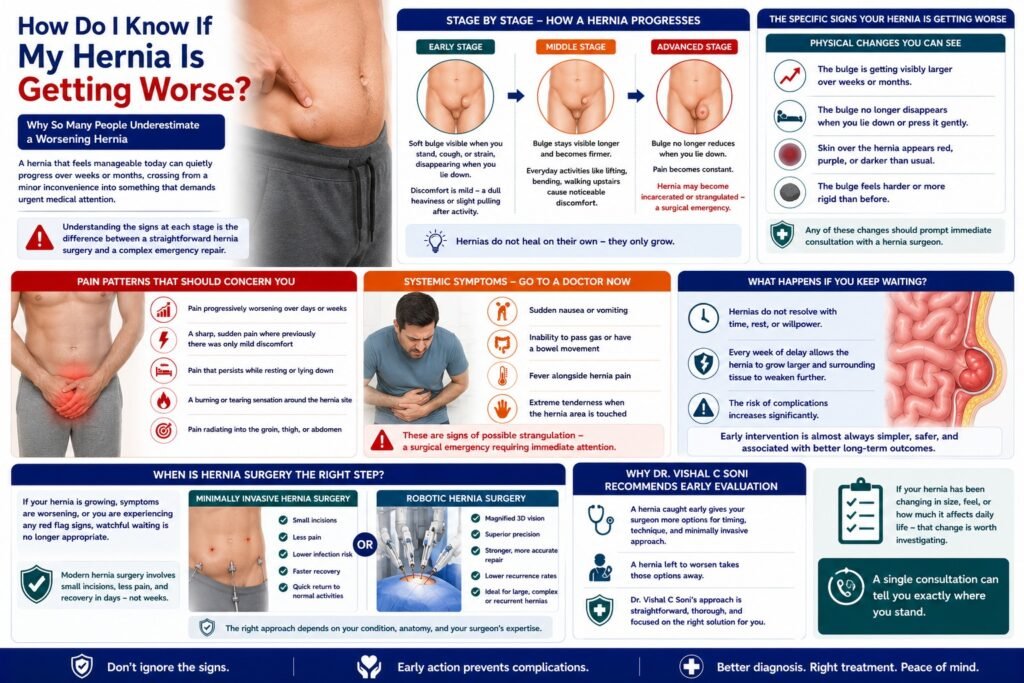
Stage by Stage – How a Hernia Progresses
Early stage A soft bulge visible when you stand, cough, or strain, disappearing when you lie down. Discomfort is mild a dull heaviness or slight pulling after activity. Early-stage hernias may not require immediate hernia surgery, but they still need proper evaluation. Hernias do not heal on their own they only grow.
Middle stage The bulge stays visible longer and becomes firmer. Everyday activities lifting, bending, walking upstairs start triggering noticeable discomfort. This is when a hernia surgeon needs to assess how far things have progressed and whether surgical intervention is the right next step.
Advanced stage the bulge no longer reduces when you lie down. Pain becomes constant. In the most serious cases, the hernia becomes incarcerated tissue trapped or strangulated, meaning blood supply is cut off. At this point, it is no longer elective. It is an emergency.
The Specific Signs Your Hernia Is Getting Worse
Physical Changes You Can See:
- The bulge is getting visibly larger over weeks or months
- The bulge no longer disappears when you lie down or press it gently
- Skin over the hernia appears red, purple, or darker than usual
- The bulge feels harder or more rigid than before
Any of these changes should prompt immediate consultation with a hernia surgeon not a wait-and-see approach.
Pain Patterns That Should Concern You
- Pain progressively worsening over days or weeks
- A sharp, sudden pain where previously there was only mild discomfort
- Pain that persists while resting or lying down
- A burning or tearing sensation around the hernia site
- Pain radiating into the groin, thigh, or abdomen
Systemic Symptoms That Mean Go to a Doctor Now
- Sudden nausea or vomiting
- Inability to pass gas or have a bowel movement
- Fever alongside hernia pain
- Extreme tenderness when the hernia area is touched
These are signs of possible strangulation a surgical emergency requiring immediate attention.
What Happens If You Keep Waiting?
Hernias do not resolve with time, rest, or willpower. Every week of delay allows the hernia to grow larger, surrounding tissue to weaken further, and the risk of complications to increase.
A hernia that could have been repaired with a clean, straightforward procedure becomes significantly more complex when strangulation or incarceration is involved. Early intervention is almost always simpler, safer, and associated with better long-term outcomes than emergency repair.
When Is Hernia Surgery the Right Step?
Not every hernia requires immediate surgery but every hernia deserves proper evaluation by an experienced hernia surgeon. If your hernia is growing, symptoms are worsening, or you are experiencing any red flag signs described above, watchful waiting is no longer appropriate.
Modern hernia surgery particularly minimally invasive approaches involves small incisions, significantly less post-operative pain, and recovery measured in days rather than weeks. The barriers that once made patients hesitate no longer apply.
For large, recurrent, or anatomically complex hernias, robotic hernia surgery is the most advanced option available. Using a robotic assisted system, the hernia surgeon operates with a magnified three-dimensional view and instruments that deliver precision beyond what conventional laparoscopic surgery can offer. This means more accurate abdominal wall repair, reduced tissue trauma, lower recurrence rates, and a smoother recovery particularly valuable when a previous repair has failed.
Why Dr. Vishal C Soni Recommends Early Evaluation?
A hernia caught early gives your hernia surgeon options for timing, technique, and the most minimally invasive approach possible. A hernia left to worsen takes those options away.
Dr. Vishal Soni’s approach is straightforward, thoroughly, explain clearly, and recommend the right path forward, whether that is monitoring, conventional hernia surgery, or robotic hernia surgery for cases demanding greater precision.
If your hernia has been changing in size, feel, or how much it affects daily life that change is worth investigating. A single consultation can tell you exactly where you stand.