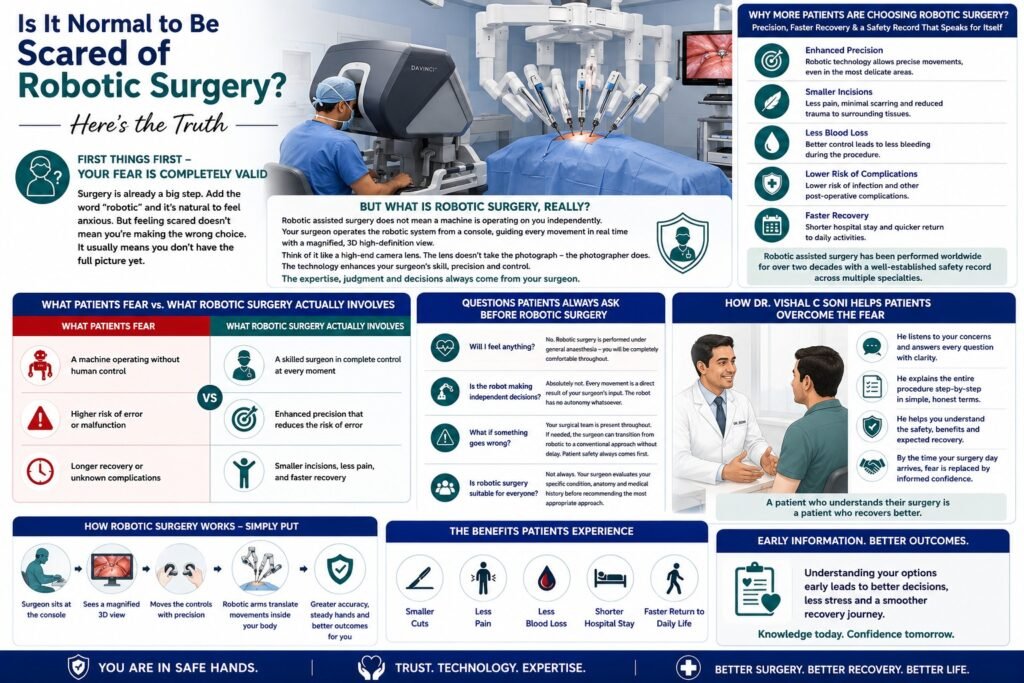
First Things First – Your Fear Is Completely Valid
Why So Many Patients Feel Anxious Before Robotic Surgery?
If the words “robotic surgery” made you pause you are not alone. Almost every patient who hears this recommendation for the first time reacts with a mix of confusion, curiosity, and if we’re being honest, genuine fear.
That fear makes complete sense. Surgery itself is already an emotional experience. Add the word “robotic” and the mind starts painting pictures that have very little to do with what actually happens in the operating room.
Here’s what matters feeling scared doesn’t mean you’re making the wrong choice. It usually means you don’t have the full picture yet.
But What Is Robotic Surgery, Really?
Let’s address the most common fear directly. Robotic assisted surgery does not mean a machine is operating on you independently. There is no robot making decisions. No automated system working without human oversight.
What robotic assisted surgery actually means your surgeon operates using a sophisticated robotic system that translates their hand movements into precise, controlled actions inside your body. The surgeon sits at a console, viewing a magnified, high-definition three-dimensional image of the surgical site, guiding every single movement in real time.
Think of it like a high-end camera lens. The lens doesn’t take the photograph the photographer does. The lens simply allows them to capture something with greater clarity than the naked eye alone. Robotic surgery works on the same principle. The robotic system gives your surgeon steadier movements, greater range of motion, and a level of precision that benefits you directly as the patient. The expertise, judgment, and decision-making all of that still comes from your surgeon.
What Patients Fear vs. What Robotic Surgery Actually Involves?
Most of us grew up watching science fiction where robots malfunction or operate with a mind of their own. That narrative sticks. And when a doctor uses the word “robotic,” that fictional image is often the first thing the brain reaches for. Social media doesn’t help eitherstories travel faster than facts.
What patients fear:
- A machine operating without human control
- Higher risk of error or malfunction
- Longer recovery or unknown complications
What robotic surgery actually involves:
- A skilled robotic surgeon in complete control at every moment
- Enhanced precision that reduces the risk of error
- Smaller incisions, less pain, and faster recovery than traditional open surgery
The gap between perception and reality is significant and bridging that gap is exactly what good patient education does.
Why More Patients Are Choosing Robotic Surgery?
Precision, Faster Recovery & a Safety Record That Speaks for Itself
Robotic assisted surgery has been performed worldwide for over two decades across multiple specialties general surgery, urology, gynecology, cardiac surgery, and more. The safety profile, when performed by a trained robotic surgeon, is well established in clinical literature. Complication rates are comparable to, and in many cases lower than, traditional open or laparoscopic surgery.
The outcomes patients consistently experience include significantly smaller incisions, reduced blood loss, lower risk of post-operative infection, shorter hospital stays, and a faster return to daily activities. For procedures involving delicate anatomy around the esophagus, stomach, or diaphragm robotic precision is often the difference between a clean outcome and a complex recovery.
The safety and success of robotic surgery depend enormously on the experience of the robotic surgeon performing it. The technology enhances what a skilled surgeon can do it does not replace the skill itself.
Questions Patients Always Ask Before Robotic Surgery:
Will I feel anything?
No. Robotic surgery is performed under general anaesthesia you will be completely comfortable throughout.
Is the robot making independent decisions?
Absolutely not. Every movement is a direct result of your surgeon’s input. The robot has no autonomy whatsoever.
What if something goes wrong?
Your surgical team is present throughout. If needed, the surgeon can transition from robotic assisted surgery to a conventional approach without delay. Patient safety always takes precedence.
Is robotic surgery suitable for everyone?
Not always. Your surgeon evaluates your specific condition, anatomy, and medical history before recommending the most appropriate approach.
How Dr. Vishal C Soni Helps Patients Overcome the Fear?
Fear before surgery is natural but it should never be something a patient carries alone into the operating room.
Dr. Vishal Soni understands that choosing robotic surgery is as much an emotional decision as a medical one. As an experienced robotic surgeon, he walks every patient through exactly what robotic assisted surgery involves what to expect before, during, and after so that by the time the procedure begins, fear has been replaced by informed confidence.
A patient who understands their surgery is a patient who recovers better. If you have been recommended robotic surgery and find yourself hesitating, a conversation with Dr. Vishal Soni may be all it takes to turn uncertainty into clarity.