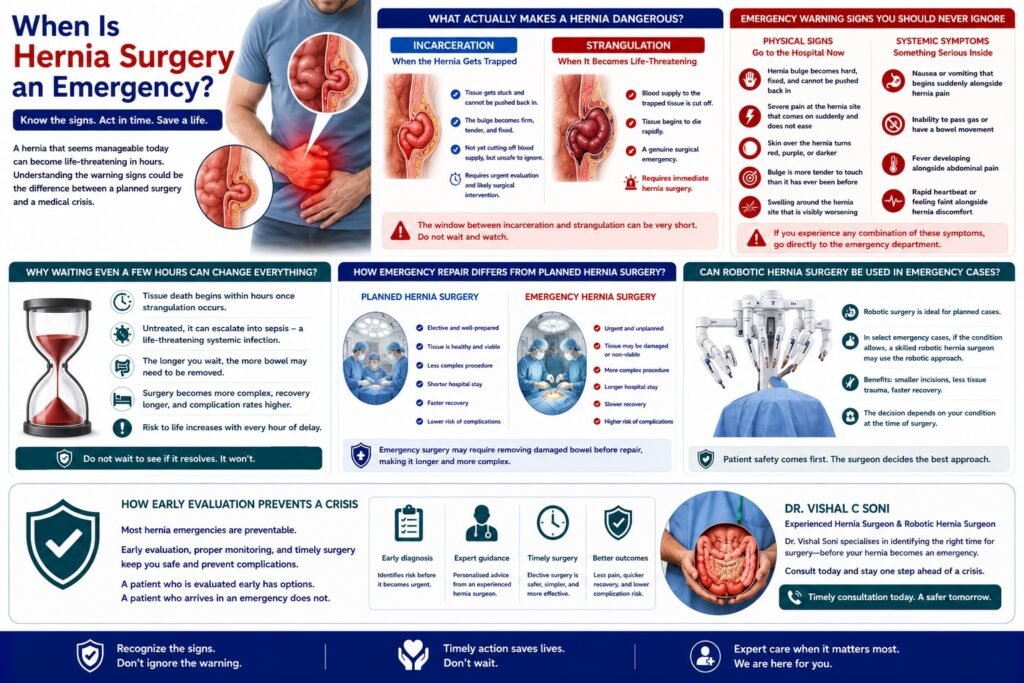
When Is Hernia Surgery an Emergency?
Understanding the Line Between a Stable Hernia and a Surgical Urgency:
Most hernias don’t start as emergencies. Many people live with a hernia for months sometimes years managing mild discomfort and monitoring for changes. For these patients, hernia surgery is a planned, elective decision made after careful evaluation with an experienced hernia surgeon.
But hernias are unpredictable. A hernia that has been stable for months can change status quickly crossing from manageable to critical in a matter of hours. Knowing where that line is could be the difference between a straightforward repair and a life-threatening situation.
What Actually Makes a Hernia Dangerous?
Incarceration – When the Hernia Gets Trapped
A hernia becomes incarcerated when the tissue that has pushed through the abdominal wall gets stuck and can no longer be pushed back in. The bulge becomes firm, tender, and fixed it doesn’t reduce when you lie down or apply gentle pressure.
At this stage, the hernia is not yet cutting off blood supply but it is no longer safe to ignore. An incarcerated hernia requires urgent evaluation by an experienced hernia surgeon and will almost certainly need surgical intervention.
Strangulation – When It Becomes Life-Threatening
Strangulation is what happens when an incarcerated hernia progresses. The trapped tissue’s blood supply is cut off entirely. Without blood flow, that tissue begins to die rapidly. A strangulated hernia is a genuine surgical emergency that requires immediate hernia surgery, no exceptions.
This is the scenario every hernia patient must understand because the window between incarceration and strangulation can be very short.
Emergency Warning Signs You Should Never Ignore:
Physical Signs That Mean Go to the Hospital Now
- The hernia bulge suddenly becomes hard, fixed, and cannot be pushed back in
- Severe pain at the hernia site that comes on suddenly and does not ease
- The skin over the hernia turns red, purple, or visibly darker
- The bulge is significantly more tender to touch than it has ever been before
- Swelling around the hernia site that is visibly worsening
Systemic Symptoms That Signal Something Serious Is Happening Inside
- Nausea or vomiting that begins suddenly alongside hernia pain
- Inability to pass gas or have a bowel movement
- Fever developing alongside abdominal pain
- Rapid heartbeat or feeling faint alongside hernia discomfort
If you experience any combination of these symptoms do not call your surgeon’s office and wait for a callback. Go directly to the emergency department. A strangulated hernia cannot wait.
Why Waiting Even a Few Hours Can Change Everything?
How a Strangulated Hernia Escalates and Why Time Is the Critical Factor
Once strangulation occurs, tissue death begins within hours. What starts as a surgical emergency can escalate into sepsis a life-threatening systemic infection if the dead tissue is not removed promptly.
The longer a strangulated hernia goes untreated, the more complex the surgery becomes. More bowel may need to be removed. Recovery takes significantly longer. Complication rates rise sharply. And the risk to the patient’s life increases with every hour of delay.
This is why experienced hernia surgeons consistently emphasise one message do not wait to see if a painful, fixed hernia resolves on its own. It won’t.
How Emergency Repair Differs From Planned Hernia Surgery?
Emergency hernia surgery follows the same fundamental principle as planned hernia surgery returning the herniated tissue to its correct position and repairing the abdominal wall defect. However, there are important differences.
In an emergency setting, the surgeon must also assess whether the trapped tissue is still viable. If bowel has been strangulated long enough to suffer irreversible damage, that section must be removed before the repair can proceed. This makes emergency hernia surgery inherently more complex, longer, and associated with a higher risk of complications than planned repair.
Recovery from emergency hernia surgery is also considerably more demanding longer hospital stays, greater post-operative pain, and a slower return to normal activity compared to elective procedures.
Can Robotic Hernia Surgery Be Used in Emergency Cases?
Robotic hernia surgery is primarily associated with planned, elective procedures and for good reason. The robotic assisted approach allows an experienced robotic hernia surgeon to operate with magnified three-dimensional vision and instruments that deliver precision beyond conventional laparoscopic tools.
In select emergency cases where the clinical situation allows a minimally invasive approach, a skilled robotic hernia surgeon may be able to perform the repair robotically offering the patient the benefits of smaller incisions, reduced tissue trauma, and faster recovery even in an urgent setting.
However, the decision always rests with the operating surgeon based on the patient’s condition at the time. Patient safety takes precedence over surgical technique always.
How Early Evaluation With Dr. Vishal C Soni Prevents a Crisis Before It Starts?
The most important thing to understand about hernia emergencies is this most of them are preventable. A hernia that is evaluated early, monitored appropriately, and repaired at the right time almost never reaches the point of strangulation.
Dr. Vishal Soni is an experienced hernia surgeon and robotic hernia surgeon who specialises in identifying when a hernia needs intervention before it becomes urgent. His approach is built around one principle a patient who is evaluated early has options. A patient who arrives in an emergency does not.
Whether your hernia is currently stable or showing early signs of change, a consultation with Dr. Vishal Soni gives you a clear picture of where you stand and a surgical plan that keeps emergency hernia surgery off the table entirely.