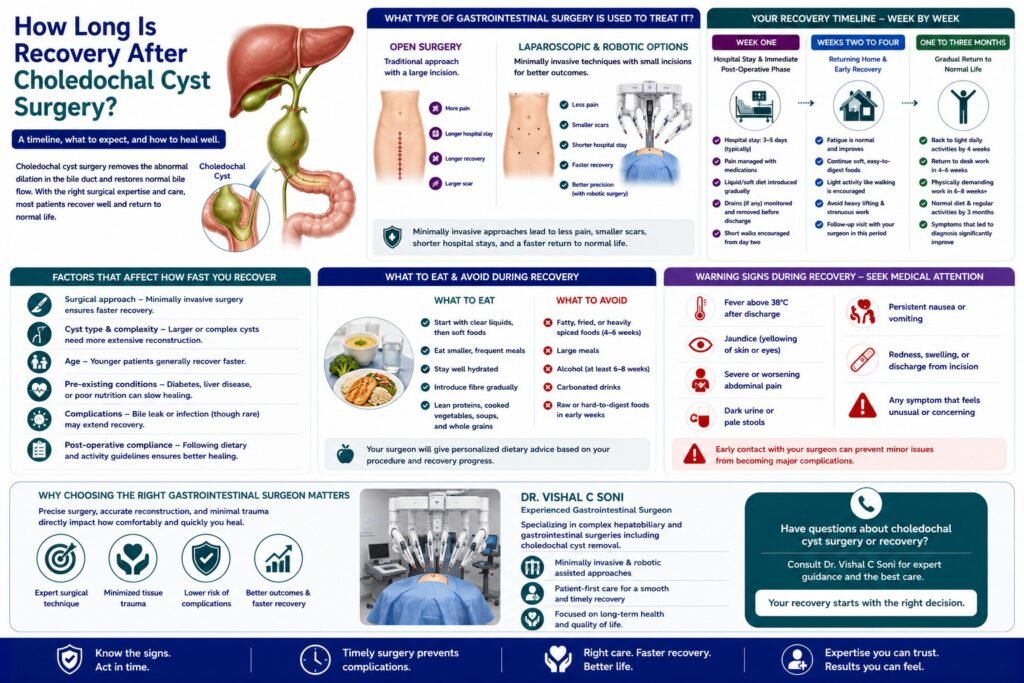
What Is a Choledochal Cyst and Why Does It Need Surgery?
A choledochal cyst is an abnormal dilation of the bile duct the tube that carries bile from the liver and gallbladder to the small intestine. Left untreated, it carries a significant risk of serious complications including recurrent infections, pancreatitis, and in adults, an elevated risk of bile duct cancer.
Unlike many gastrointestinal conditions that can be managed with medication, choledochal cysts cannot be resolved without surgical intervention. Gastrointestinal surgery to remove the cyst and reconstruct the bile duct pathway is the only definitive treatment and when performed by an experienced gastrointestinal surgeon, it delivers excellent long-term outcomes.
What Type of Gastrointestinal Surgery Is Used to Treat It?
Minimally Invasive vs. Open Approaches – How the Technique Affects Recovery
The surgical approach chosen for choledochal cyst removal directly influences recovery time, comfort, and outcomes. Traditionally, open gastrointestinal surgery was the standard involving a large abdominal incision, a longer hospital stay, and a recovery that could stretch to several weeks.
Laparoscopic & Robotic Options
Today, most choledochal cyst surgeries are performed using minimally invasive techniques. Laparoscopic gastrointestinal surgery uses small keyhole incisions and a camera to guide the procedure. Robotic assisted surgery takes this further giving the gastrointestinal surgeon a magnified three-dimensional view and instruments with precision and range of motion beyond conventional tools.
For patients, this translates directly into less post-operative pain, smaller scars, shorter hospital stays, and a meaningfully faster recovery compared to open surgery.
Your Recovery Timeline Week by Week
Week One – Hospital Stay & Immediate Post-Operative Phase
Most patients remain in hospital for three to five days following choledochal cyst surgery, depending on the surgical approach and individual recovery. During this period:
- Pain is managed with intravenous and oral medications
- A liquid or soft diet is introduced gradually as the gastrointestinal system resumes normal function
- Drainage tubes, if placed during surgery, are monitored and typically removed before discharge
- Short walks within the ward are encouraged from day two early movement significantly reduces the risk of complications
Weeks Two to Four – Returning Home & Early Recovery
This is the phase where most patients make significant progress but also where patience matters most. At home during this period:
- Fatigue is normal and should be respected rest is an active part of recovery
- Soft, easily digestible foods continue as the digestive system adjusts
- Light activity such as short walks is encouraged; strenuous activity and lifting must be avoided
- Follow-up with your gastrointestinal surgeon is typically scheduled within this window to assess healing and review pathology results
Most patients who underwent minimally invasive gastrointestinal surgery are feeling meaningfully better by the end of week three.
One to Three Months – Gradual Return to Normal Life
By the end of the first month, most patients are back to light daily activities. A full return to work for desk-based roles is typically possible between four to six weeks post-surgery. Physically demanding work may require six to eight weeks or longer.
By three months, the vast majority of patients have returned to a normal diet, resumed regular activity, and report a significant improvement in the symptoms that led to their diagnosis.
Factors That Directly Influence How Fast You Recover
No two recoveries are identical. Several factors shape how quickly an individual patient heals after choledochal cyst gastrointestinal surgery:
- Surgical approach – Minimally invasive surgery consistently delivers faster recovery than open surgery
- Cyst type and complexity – Larger or more complex cysts require more extensive reconstruction, which affects healing time
- Age – Younger patients generally recover faster, though older patients do very well with minimally invasive approaches
- Pre-existing conditions – Diabetes, liver disease, or poor nutritional status can slow healing
- Complications – Bile leak or infection, though uncommon, extend recovery if they occur
- Post-operative compliance – Patients who follow dietary and activity guidelines consistently recover faster
What to Eat & Avoid During Recovery?
Since choledochal cyst surgery directly involves the bile duct and digestive reconstruction, diet plays an important role in recovery. General guidance from most gastrointestinal surgeons includes:
- Begin with clear liquids and progress to soft foods as tolerated
- Avoid fatty, fried, or heavily spiced foods for the first four to six weeks
- Eat smaller, more frequent meals rather than large portions
- Stay well hydrated throughout recovery
- Avoid alcohol entirely for at least six to eight weeks post-surgery
- Introduce fibre gradually to support healthy bowel function without causing bloating
Your gastrointestinal surgeon will provide specific dietary guidance tailored to your individual procedure and recovery progress.
Warning Signs During Recovery You Should Never Ignore:
Most recoveries from choledochal cyst surgery are smooth but it is important to know when something needs prompt medical attention. Contact your gastrointestinal surgeon without delay if you experience:
- Fever above 38°C that develops after discharge
- Jaundice – yellowing of the skin or eyes which may indicate a bile duct issue
- Severe or worsening abdominal pain that is not controlled by prescribed medication
- Dark urine or pale stools, which can signal bile flow problems
- Persistent nausea or vomiting preventing adequate food and fluid intake
- Redness, swelling, or discharge from any incision site
These symptoms are not common but they are important. Early contact with your surgical team prevents minor concerns from becoming significant complications.
Why Choosing the Right Gastrointestinal Surgeon Changes Your Recovery?
Recovery after choledochal cyst surgery is shaped as much by what happens in the operating room as by what happens at home. The precision of the surgical technique, the accuracy of the bile duct reconstruction, and the minimisation of intraoperative trauma all directly influence how comfortably and quickly a patient heals.
Dr. Vishal C Soni is an experienced gastrointestinal surgeon with deep expertise in complex hepatobiliary and gastrointestinal surgery including choledochal cyst removal. Using minimally invasive and robotic assisted approaches wherever clinically appropriate, his focus is on achieving the most precise surgical outcome with the least possible impact on surrounding tissue giving every patient the best possible foundation for a smooth, timely recovery.
If you or someone you care for has been diagnosed with a choledochal cyst and has questions about surgery, recovery, or what to expect at every stage, a consultation with Dr. Vishal Soni is the clearest next step.